OPEN AIR EXHIBITION MARCUSHEIDE
SIGNS OF CHANGE


BLACK SUMMER

From June 2019 to March 2020, Australia was ravaged by the worst bushfires the country has ever experienced. While the fires were still raging, it was given its name: Black Summer - also the title of Matthew Abbott's series. The »black« summer left behind charred animals with pain-distorted facial expressions, cars that look like carcasses, charred forests and grotesquely out-of-place swimming pools.
Photographer Matthew Abbott has photographed all of this up close in a way that takes your breath away. The heat seems palpable on the skin. Smoke and fumes seem painfully real. His series is borne of deep compassion for the victims of the catastrophe, as 34 people died in the flames, which were up to 100 meters high. An estimated 186,000 square kilometers of land, nearly 6,000 buildings and nearly three billion animals burned, including from species that were already threatened with extinction beforehand. Matthew Abbott: »Gradually, I realized that I was witnessing what fire historian Stephen Pyne calls the pyrocene: an age that threatens to unhinge the planet.«

Matthew Abbott. Born in Sydney in 1984. Australian photojournalist. He studied International Photojournalism at the Danish School of Journalism in Copenhagen and holds a Master of Arts from the University of Sydney. Abbott has won most prestigious awards for photojournalism: three World Press Awards and four Walkleys. He photographs and writes for the New York Times. He placed second in the World Press Photo 2020 spot news category with »Black Summer«. He is represented by Panos Pictures in London and is a member of the Australian collective Oculi.
GLACIER MELTING

In recent decades, most glaciers in the Swiss Alps have been melting faster than at any time since records began, driven by rising temperatures and increasingly frequent summer heat waves. As a result, glaciers have become a powerful symbol of climate change.
In many regions, glaciers are also an important economic factor, particularly where they support ski tourism. For this reason, the first attempts to partially cover a glacier with white textile sheets began in 1993 on the Zugspitze in southern Bavaria. The idea was later adopted for the Rhone Glacier in Switzerland.
Covering approximately 50,000 m², it is the largest glacier cover in Switzerland and is designed to slow the melting of the glacier tongue. Its main purpose is to protect the ice grotto, which is an important tourist attraction. While the covers can help preserve the ice locally, they have also been criticized because of their high cost and environmental impact.
The accelerated ice loss expected as a result of climate change cannot be halted by technological solutions. “The only way to effectively limit the global retreat of glaciers is to reduce greenhouse gas emissions and thus the warming of the atmosphere,” says Matthias Huss of the Swiss Federal Institute for Forest, Snow and Landscape Research (WSL).

FRIDAYS FOR FUTURE
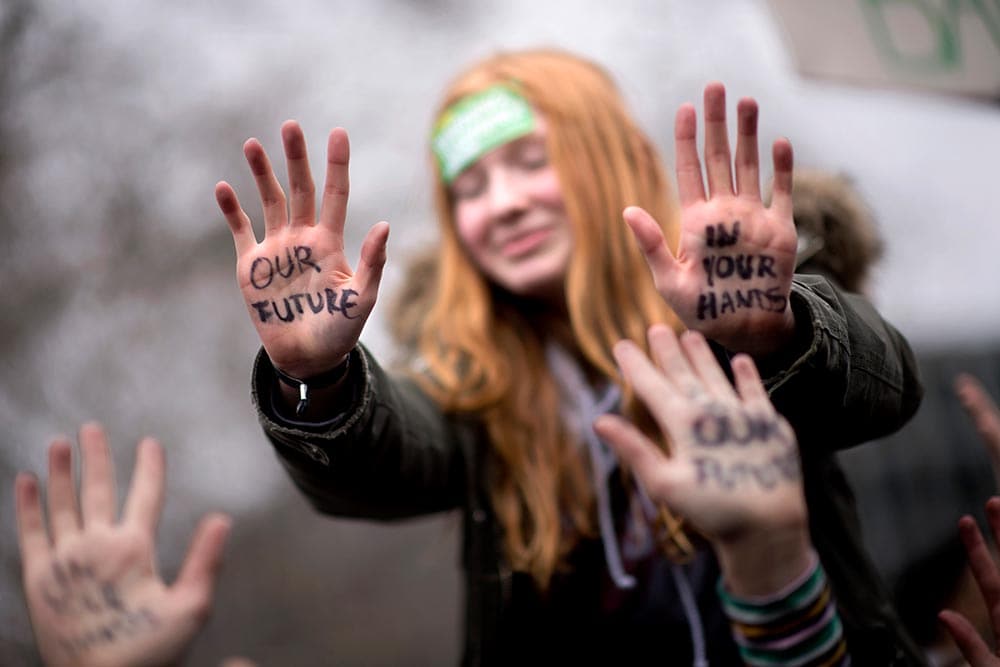
The Fridays for Future movement began in 2018 with the initial solo protest of Swedish climate activist Greta Thunberg and has since gained worldwide attention. With its new form of extra-parliamentary protest, it has become one of the largest global movements of our time.
Stefan Boness’s photographs go far beyond straightforward photojournalism. They capture the colorful, creative and deeply peaceful character of the protests. Handmade cardboard signs with pointed slogans, determined faces illuminated by countless lights, and the energy of mass demonstrations come together in his work as visual records of a defining moment in time. His photographs invite viewers to experience the energy of this historic wave of protest and to reflect on an urgent question: How can we safeguard the future of coming generations?
Although the movement is currently less active, its message remains highly relevant as temperatures and heat waves continue to rise: “Our house is on fire” and “What do we want? Climate justice! When do we want it? Now!”

Stefan Boness lives and works in Berlin and Manchester. After studying political science and gaining several years of experience as a photo editor, he has worked as a freelance photojournalist since 1997. His photographs have received numerous awards, including the internationally renowned Alfred Fried Photography Award and a World Press Photo Award. Alongside his work covering current events, he also develops long-term documentary projects, many of which are published as books.
Website
Instagram
FOG NETS

Lima is the second-largest city in the world, after Cairo, to have been built in a desert. Although it lies on the Pacific coast, the Peruvian capital receives less than 15 millimeters of rainfall each year. In recent decades, migration from rural areas of Peru to Lima has increased significantly. Many of those settling on the outskirts of the city live in poverty, and access to water is one of their greatest challenges. Many families depend on water delivered by tanker trucks and pay up to ten times more than residents connected to the municipal water system.
To help address this crisis, environmental engineer Abel Cruz developed a simple yet innovative solution: large mesh nets installed on the slopes surrounding the city capture moisture from Lima’s dense coastal fog. As the fog passes through the nets, tiny droplets condense on the surface and are channeled into storage tanks. A single fog collector can provide between 200 and 400 liters of water per day.
The project offers a sustainable, cost-effective, and easily replicable solution for one of the driest capital cities in the world. It demonstrates how an invisible natural resource can become a lifeline for communities on the outskirts of the city. According to Abel Cruz, 140 fog nets have now been installed in Lima.

His work has been featured in 81 solo and group exhibitions in 29 countries. He has also been recognized as a finalist or winner in international competitions and awards, including World Press Photo, Prix Pictet, the W. Eugene Smith Grant, POYi, the Leica Oskar Barnack Award, the Alexia Grant, Vital Impacts, and the BarTur Photo Award.
THE BLUE FIG

In contrast to regions where climate change is still only subtly felt, its consequences in Bangladesh are stark and unrelenting. Coastal communities face ever-stronger cyclones, storm surges, and rising sea levels with little protection. The growing salinity of the soil and water is contaminating freshwater sources, triggering severe health crises. As arable land disappears and fish stocks decline, food insecurity deepens—driving more and more people to leave their homes and seek refuge in cities.
»The Blue Fig« erforscht mit sehr intimen und visuell fesselnden Bildern die Folgen der Umweltzerstörung. Aber die Fotografien zeigen nicht nur die Zerstörungen, sondern auch die Widerstandsfähigkeit und den stillen Trotz der Menschen, die am Rande der Katastrophe leben. »The Blue Fig« ist somit ein Zeugnis des Überlebens. Diese Bilder unterstreichen die Dringlichkeit globaler Klimamaßnahmen und ehren gleichzeitig den unbeirrbaren Geist derjenigen, die sich weigern, zu kapitulieren.

Mohammad Rakibul Hasan is a documentary photographer, filmmaker, visual artist, and art educator based in Dhaka, Bangladesh. His work centres on human rights, social development, politics, the environment, and spirituality. As a visual journalist, he contributes to ZUMA Press, Redux Pictures, Inter Press Service, and the Thomson Reuters Foundation. Hasan’s photography has been exhibited internationally, including at Photo Basel, the Shanghai Photo Festival, the Berlin Photo Festival, and in numerous galleries around the world.
NET-ZERO TRANSITION

Over the past decade, global temperature data have confirmed an acceleration in global warming, bringing climate change to the forefront of economic, industrial, and political decision-making. In response, the European Union launched the “Green Deal,” creating a framework for the structural reduction of CO₂ emissions. In recent years, despite signs of a slowdown linked to shifting geopolitical priorities, the Green Deal has become an important driver of innovation and development.
Tramonte’s long-term project “Net-Zero Transition” does not aim to provide definitive answers, but rather to document a transformation that is already underway. Across Europe, production systems are being reorganized around new approaches to energy, food, and resource management. The project presents this historic phase as an inspiring transformation, with measurable results and visible, practical applications.

Simone Tramonte is a documentary photographer whose work focuses on environmental issues as well as current technological and social change. He combines photojournalism with aesthetic exploration to encourage debate about the challenges of our time.
His work has been published in leading international magazines and exhibited worldwide at festivals, museums, and galleries. He has received numerous awards for his “Net-Zero Transition” project, including the 2021 Sony World Photography Award and a 2023 World Press Photo Award.
Website
Instagram
THE GREAT GREEN WALL

The “Great Green Wall” is one of the most ambitious environmental projects of our time. Stretching across the African continent along the arid Sahel region, it aims to create an 8,000-kilometer belt of trees and vegetation. The project is intended to slow the spread of the Sahara Desert, restore degraded soils, and create new economic opportunities for millions of people in their home regions.
This multi-billion-dollar initiative aims to restore a vast strip of land across the continent, helping to combat desertification and improve food security. However, the project has faced significant challenges, and many of its individual initiatives have failed. Even so, local communities from Dakar to Djibouti continue working to keep the vision of the “Green Wall” alive.
Trenchard’s photographs, taken primarily in the desert oases of Chad, are far more than an ecological record. They offer a powerful visual account of human resilience, the strength of collective action, and the global struggle to protect our planet.

Website
Instagram
SOLAR KIOSK

Ghana is one of the fastest-growing solar energy markets in Africa. In her photographic series, Sandra Weller focuses, among other projects, on a solar kiosk in Dauda, a cocoa-farming village.
The solar kiosks operate using a simple rental system. For a small fee, residents can charge solar lamps, mobile phones and radios during the day in secure charging compartments. The lamps can either be rented or purchased. Each kiosk is managed by a local operator.
This provides reliable access to clean energy while also creating jobs, developing local expertise and supporting sustainable infrastructure. So far, 72 solar kiosks have been built, most of which are now operating in different regions of Ghana.
Sandra Weller has developed a distinctive visual language for her photographic reportage on climate justice. Her images create a narrative link between practical environmental projects within a village community and broader questions surrounding climate change.

Sandra Weller is a freelance photographer based in Frankfurt am Main, Germany. She studied photography at the Maastricht Academy of Fine Arts in the Netherlands. In 2022, her work received an award in the “Climate of Change” category at the internationally renowned Earth Photo Awards. In 2023, she received the Lagois Award for Emerging Photographers for her work on climate justice. In 2025, she served as a member of the jury for the Lagois Photo Competition.